Name Change Mystery

I am back from England and doing supplemental research on Tirrells and Bescobys found there.

Sarah Tirrell, the daughter of Philip Tirrell and aunt of Thomas Bescoby Tirrell (my 4th great-aunt), was born in Horbling, Lincolnshire, about 1831. According to Massachusetts Marriage Records, in 1860, she married a Charles Augustus Ferdinand Wenskowsky in Boston MA, USA. It was her second marriage, as her first husband, Thomas Brown, seems to have died in England soon after the marriage.

One part of the mystery comes in December 14, 1863. Charles, Sarah, and their daughter, Caroline Louise, change their names to Bowers (Massachusetts Name Changes, 1780-1892). They are living in Chelsea MA. There is no record of Charles, her husband, changing his name. In fact, Civil War draft records list a Charles Wenskowsky, married, living in Malden and working as a watchmaker. His marriage record lists him as a mariner. The 1864 Chelsea Directory lists a Charles Wenskowsky living in Chelsea and working at a powder magazine.

It appears that Charles and Sarah had more children. The 1870 US Census lists a Charles and Sarah Bowers living in Brooklyn, Ward 13, with 2 daughters Caroline (7) and Jennie (7 months), and 2 sons Frank (4) and Edwin (2). Charles is working as a furniture dealers and by 1875 they are doing well enough to have a servant.

The State of New York Death Certificate and Record of Death in Queens states that a Sarah Bowers died on November 4, 1901 of pneumonia and heart disease. This appears to be Sarah Tirrell, as the certificate lists her parents as Philip and Sarah Tirrell from England. She is a widow at this time, living in a tenement at 127-3rd St in the 1st Ward. She had been in New York City for 1 year and in the US for 45 years. She was buried at Cypress Hill on November 6th. There is also a Charles F Bowers buried in same section and lot who died in 1876, as well as a George B Bowers in the same section and lot who also died in 1876. The Charles Bowers who died in 1876 is likely Sarah’s husband, as the 1880 US Census lists a Sarah Bowers, widowed, with Carrie, Frank, Edwin, and Jenny living in Queens. Sarah is keeping house.

The second part of the mystery involves other Wenskowskys who changed their names to Bowers. The Massachusetts Name Changes records do have a Herman Bowers, living in Boston, changing his name to Herman Wenskowsky in 1875. It appears this might have been an error, and Wenskowsky changed his name to Bowers. There is a Herman Wenskowsky took the oath of US Naturalization on October 18, 1875 as well as a Massachusetts birth record that lists a son, Adolph. There is a Herman Wenskowsky estate index from Alleghany, PA in Nov 1921, that lists an Adolph Bowers as executor. In 1890s, there are 4 Wenskowsky men living in Pittsburgh at 99 Dinwiddie. One is an Adolph Wenskowsky. Another is an Edwin Wenskowsky, who was a musician. The Feb 9, 1898 Pittsburgh Press reports that the No 2 Common Pleas court allowed Edwin Wenskowsky to change his name to Edwin Bowers. I imagine there is more to come in exploring the Wenskowskys.

Posted in 1850s, 1860s, 1870s, 1880s, 1890s, 1900s, 1910s, 1920s, England, Lincolnshire, Massachusetts, New York, Tyrrell | Tagged , , , , | Leave a comment

Genealogical travels

I’m about to head to Lincolnshire, England, to do some on the ground genealogy work on the Tirrell/Tyrrell and Bescoby families. Not sure what I can find out, which is exciting.

Posted in Uncategorized | Leave a comment

John Walker Nelings

The Nelings family appeared to have a history of unmarried siblings who lived together on farms. My dad would tell of fond memories he had on his great aunts and uncles farm in South Dakota. James, Henry Claude, David Dickie, Sarah Maud, and Bessie Nelings lived on the family farm and homestead in Foster Township. My dad would spend most of the summer there working on the farm and many Sunday meals would be at the new farmhouse. The farm was owned by the bachelor brothers, and the sisters took care of the house.

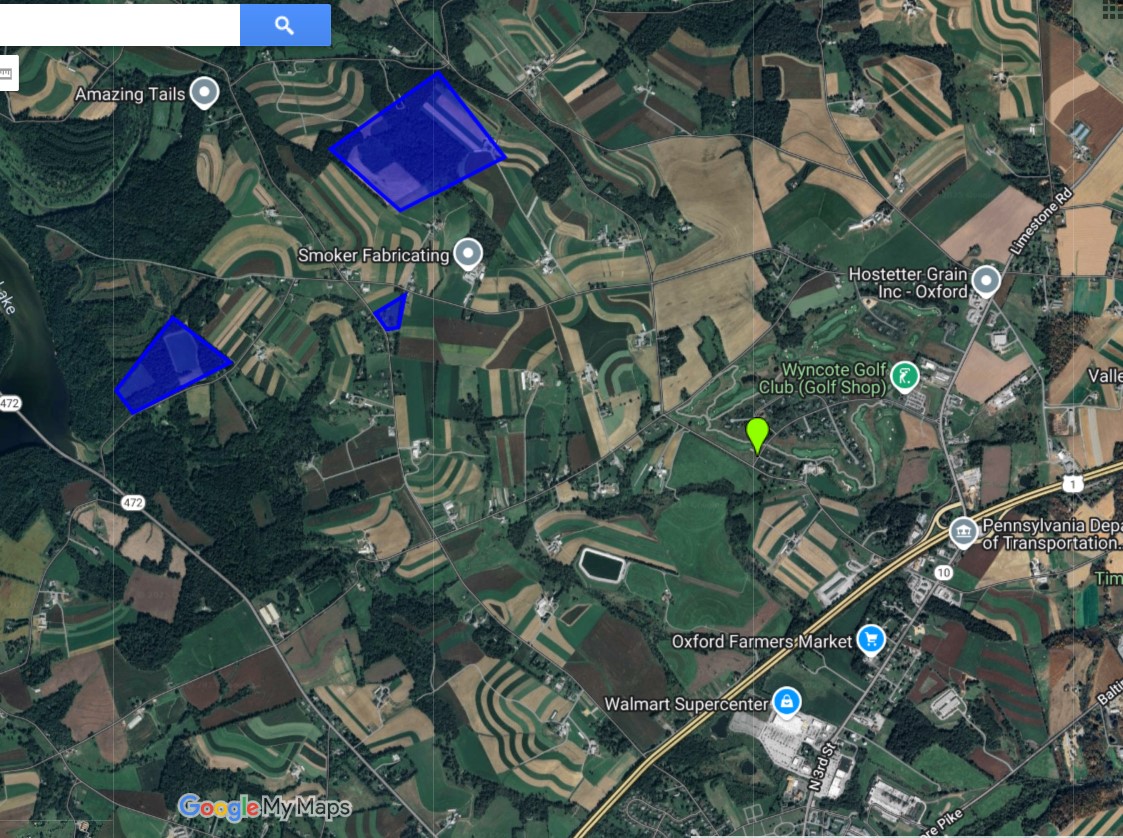
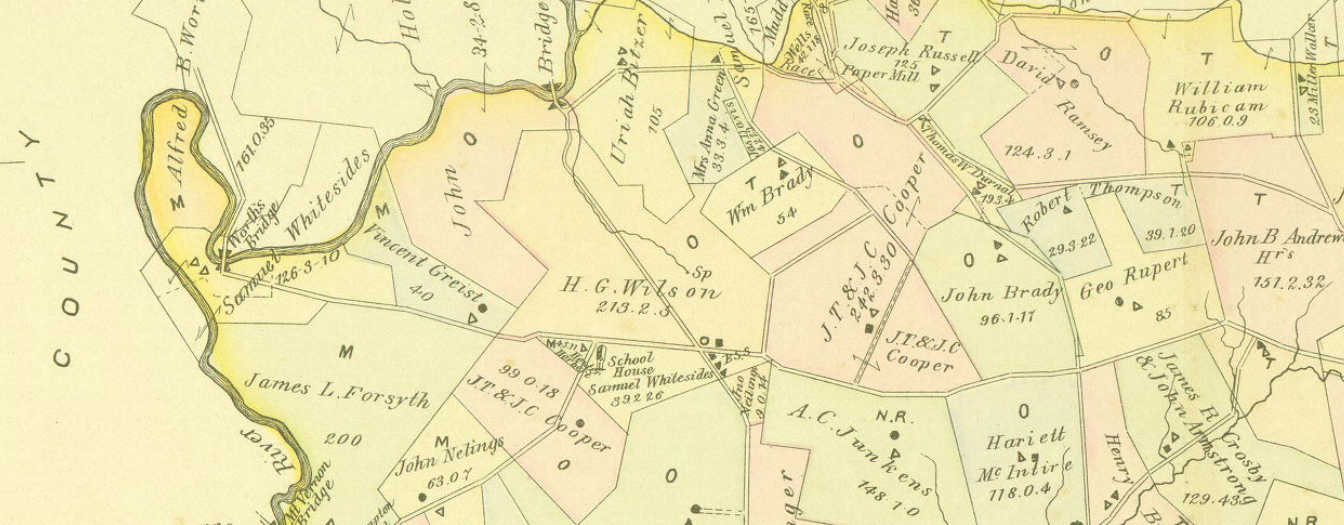
Back in Chester County, Pennsylvania, the unmarried great aunts and uncles of the South Dakota Nelings also lived on a farm passed down to the brothers. The farm, with smaller acreage, was originally owned by their father, John Walker Nelings (1806-1881, married to Mary Brady). John Walker Nelings, Jr. (1854-1902), Alexander Nelings (1852-1922), Maria Nelings (1850-1902), and Martha W. Nelings (1856-1924) all remained single and lived together at the family farm throughout their lives.

The history and size of the farm can be found in legal notices in local papers, as well as county tax records.

10/30/1870: The Jeffersonian (West Chester) reports that the farms of William Worth were sold. One farm, of 129 acres and 74 perches, was sold to John Neelings.

1871-Chester Co. Tax Records (all from Chesco.org) list John W. Nelings in Lower Oxford. John Neelings & Sons. 70 acres at $55, 2 horses $150. 1 carriage $75. No watch listed on tax record.


1872-Chester Co Tax Records lists in Lower Oxford. John Nelings & Sons. 70 acres at $3850. 3 horses $250. 2 cattle yoke oxen $170. Carriage. $75


1881-Chester Co Tax Records. John Nelings & Son in Lower Oxford. 70 acres at $40. 8 acres at $35. 4 horses at $50. 5 cattle at $20. 1 carriage at $50.

1882-Chester Co Tax Records. Estate of John Neelings joint owner. Alexander is named. Lower Oxford. Same property with exception of 3 cattle. John W. Nelings, the father, passed away in 1881.

1885-Chester Co Tax Records. John Nelings, Jr., with brother Alex in Lower Oxford. 70 acres at $40/acre. 8 acres at $35/acre. 4 horses. 2 cattle. 1 carriage.


1888-Chester Co Tax Records. Listed with brother in Lower Oxford, Mount Vernon PO. One farm. 21 acres, 66 acres, 12 acres timber, 4 horses, 8 cattle.


12/5/1888-(West Chester) Daily Village Record reports that a farm of 54 acres belonging to estate of late William Brady was sold to John Neilings for $20/acre. Brady is likely related to John’s mother.


1889-Chester Co Tax Records. Listed with brother as co-owners of 2 separate farms. Lower Oxford/Mount Vernon PO. 45 acres, 5 acres of timber. 75 acres, 12 acres of timber, 5 horses, 7 cattle.


1890-Chester Co Tax Records. Listed with brother as co-owners of 2 separate farms. Lower Oxford/Mount Vernon PO. 45 acres, 5 acres of timber. 75 acres, 12 acres of timber, 5 horses, 5 cattle.


1895-Chester Co Tax Records. Listed with brother as co-owners of 2 separate farms. 75 acres. 12 acres, 4 horses, 11 cattle and 50 acres. Mount Vernon PO. NW of modern Oxford.


1899-Chester Co Tax Records. Listed as co-owner with brother of 2 separate farms. 1. 75 acres, 12 acres, 4 horses, and 5 cattle. 2. 50 acres, 30 acres.

1900-Chester Co Tax Records. Listed as co-owner with brother of 2 separate farms. 1. 75 acres, 12 acres, 4 horses, and 8 cattle. 2. 50 acres, 30 acres.

John Walker Nelings, Jr. died suddenly on September 6, 1903 from heart trouble. He was found on the floor in the stable of the barn by Alexander. One sister, Maria, predeceased him on January 10, 1902, from pneumonia. Alexander and Martha remained on the farm until the 1920s. Alexander died on August 27, 1922 and Martha died on May 5, 1924.

Atlas of Chester Co, Pennsylvania, 1873. philageofhistory.org
Chester County, Pennsylvania, 1883. philageofhistory.org
Blue areas are approximate locations of the Nelings farms from 1870s-1920s

Posted in 1880s, 1890s, 1900s, 1910s, 1920s, Nelings/Neilings/Neelings, Pennsylvania, Uncategorized | Tagged , , , | Leave a comment

A.H. Marsland

For the past 11 months I have been going through photos and ephemera that my mom and dad had. It seemed like at least once every few years my sisters and I would go through the boxes with my dad. We would read the Civil War letters, study the daguerreotypes, and just generally listen and learn. In the last few years of my dad’s life, he remembered less about the items and who owned them or where they came from, especially when asked directly. He was still very interested in them, but the details of who these photos was just out of reach.

I have been working to preserve and catalog the items in order to share them with the greater family.

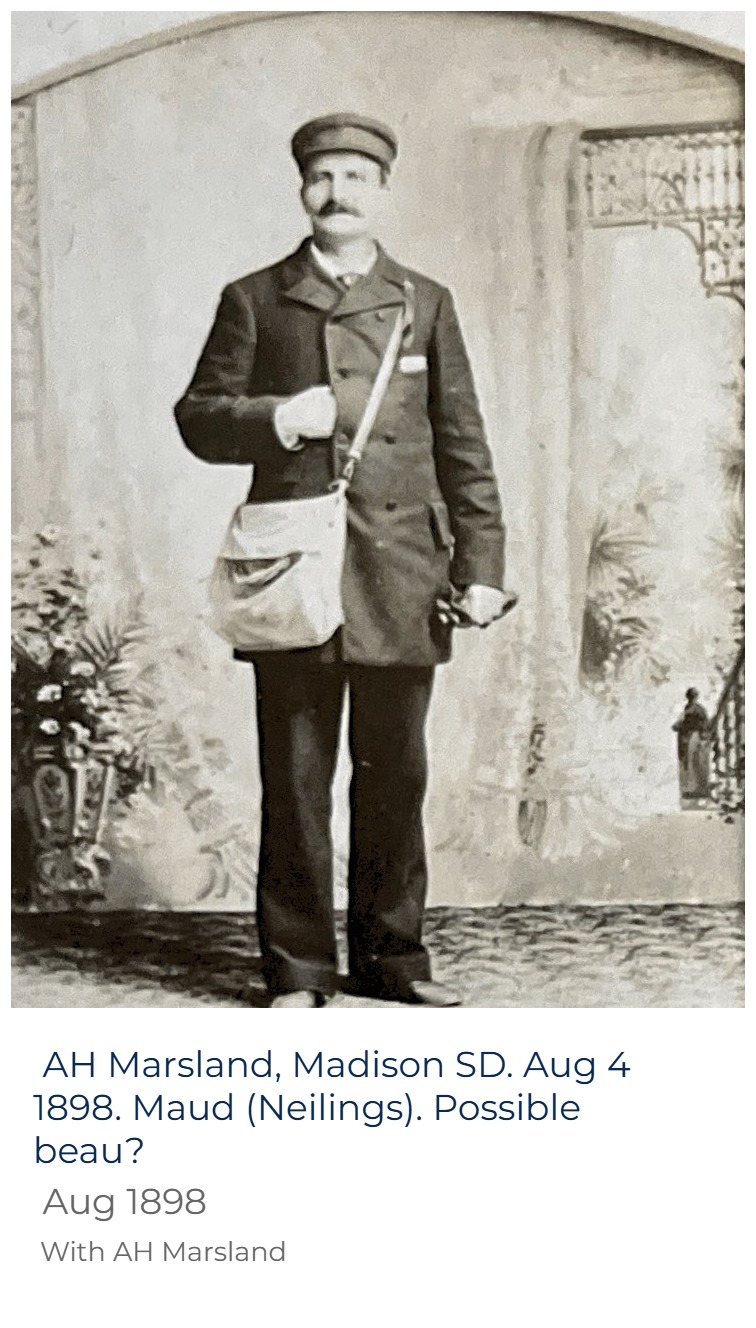
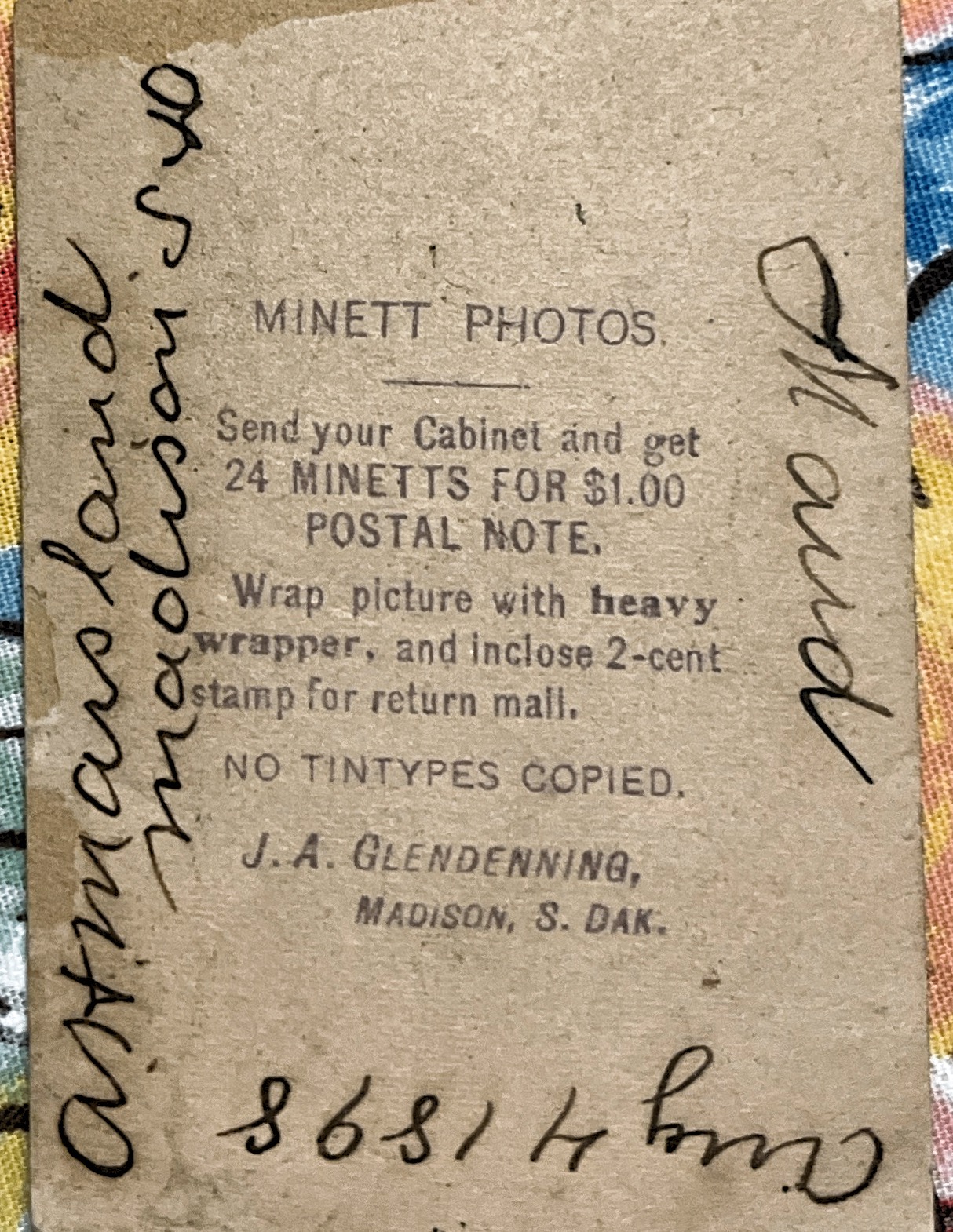
One such person is Albert Henry (A.H.) Marsland. We have a photo of him in what appears to be a uniform. A handsome man with a luxuriant mustache, hat, double breasted jacket, with his right hand in his jacket and his left clutching what might be gloves. He has what is likely a canvas cross-body bag. On the back is “Minett Photos…J. A. Glendenning, Madison SD.” The date is August 4, 1898. His name and the name of my great-aunt [Sarah] Maud [Nelings] is on the back.

I decided to do a little digging, as I knew nothing about him. In fact, I thought he might have been a beau of Maud.

A.H. Marsland was born June 11, 1855 in Burlington WI to Thomas H (T.H.) and Sarah Marsland and died on November 28, 1933 in Green Bay WI. As a child, his family moved to Missouri. He married Mary Nelson in 1879 in Kansas in front of a probate judge and by 1880 was living in South Dakota with his uncle, William Metcalf. The 1900 US Census reports that he could not read or write but was doing well enough to have a servant.

In 1883, A.H. traveled back to Burlington WI, lauding the economic and agricultural opportunity in Lake County. According to the Lake County Leader (reported in the Burlington (WI) Free Press on April 24, “Mr. Marsland is a reliable man, and a rustler, and has done as much as any one man in this section toward settling Lake county with first-class citizens.” His father, Thomas, was not as enamored with Dakota Territory. That same year, he visited his son and returned with him to Wisconsin. Thomas said “those who have good homes in the States had better remain” (Burlington (WI) Free Press, April 24, 1883, p. 1).

A.H. was a member of the International Order of Odd Fellows, Madison lodge 20. in 1890.

In the 1890s, A.H. worked as a janitor and engineer at the Madison Normal School (the teacher’s college, now known as Dakota State University). He was responsible for plumbing the school for hot and cold water, as well as repiping the steam heat and radiators (Madison Daily Leader, Aug 29, 1893, p. 3). The South Dakota Report of the Auditor (1894) shows he was paid $866.69 for his work as a janitor/engineer. The Madison paper lauds him as “conscientiously devoted to the comfort of the students and the interest of the state.”

A.H. traveled with several people from Madison S.D. to the 1893 World’s Columbian Exposition in Chicago. He may have tried the Ferris Wheel, Juicy Fruit gum, and Cracker Jacks, which all debuted at the Fair.

Marsland had moved back to Wisconsin by 1913, although he made frequent trips back to South Dakota, including the Black Hills.

I wonder if Marsland’s family has a photo of Sarah Maud Nelings among their family papers and wonder who she was.

Posted in 1880s, 1890s, 1900s, 1910s, 1920s, Dakota Territory, Nelings/Neilings/Neelings, Uncategorized | Tagged , , , , , | 1 Comment

A hiatus

My dad died suddenly of pancreatic cancer. It took 6 weeks from first indication until his death. In all other respects he was an active, vibrant cognitively with it 93 year old. I moved closer to him in May and moved him into my new house in June. He had but a brief time to enjoy the views of the mountains and the orchard.

I am unable to more.

Posted in Uncategorized | 2 Comments

New Hampshire Grants

In all my research about Cheney land ownership in Vermont, I didn’t even think to look at the history of land ownership in New England. And doing so made me realize how little I learned and know about the history of Colonial America and the 18th century in New England.

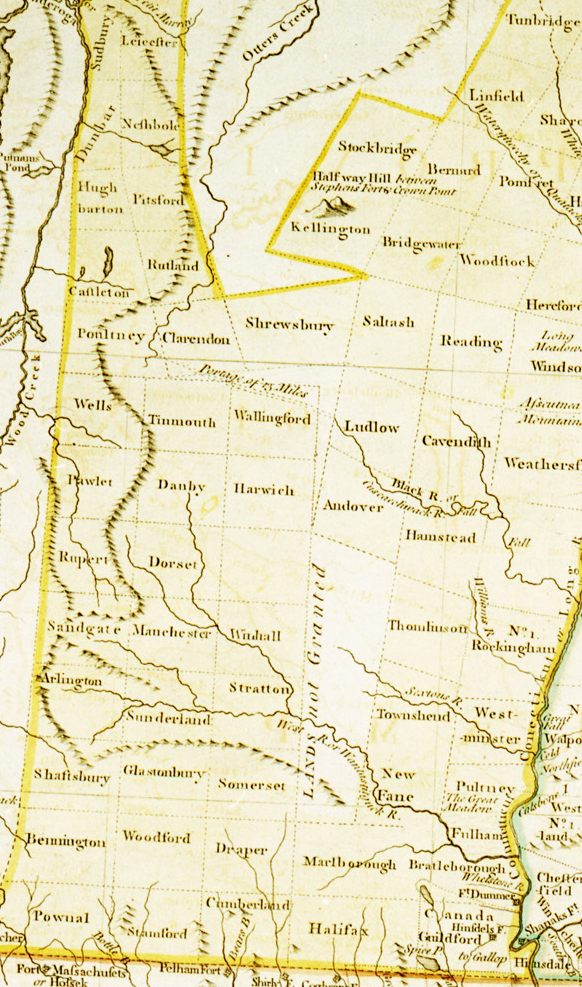
For example, the New Hampshire Grants, which were the original grants of land in present-day Vermont made by then-Governor of New Hampshire, Benning Wentworth. These grants were made starting in 1741 and continued through 1766 (https://vermonthistoryexplorer.org/the-new-hampshire-grants). Grants include the towns of Neshobe (now Brandon), Rutland, and Tinmouth.

Thomas Jeffreys map of 1774 from Vermont Historical Society

There was a wrinkle in Benning’s plan to extend the reach of New Hampshire, and that was the colony of New York and King George III. In 1764 the Lieutenant Governor of New York, Cadawallader Colden, reached out to the King for a decision on where the boundary between New York and New Hampshire was. The King said the Connecticut River, which is now the eastern border of Vermont. As a result, the European settlers who paid money for a New Hampshire grant were now asked to pay another purchase price to New York to keep their land ( http://Vermont Historical Society. “The 14th State.” Vermont History Explorer. Accessed August 11, 2023. https://vermonthistoryexplorer.org/the-14th-state). Ethan Allen and the Green Mountain Boys came out of this dispute over paying additional moneys for land they had already purchased, running off anyone who came from New York to try and enforce the King’s decision.

The Colony of New York mapped out areas of Vermont and there are some detailed maps showing ownership. The approximate locations of the town of Brandon and Rutland Vermont are shown on one such map, below, circled in green, with Brandon being north of Rutland. They appear to be part of a Charlotte County which was a colonial county in New York created in 1772 and contained western Vermont. (Charlotte County was named after Princess Charlotte, the daughter of George III. In 1784, the name of the county was changed to Washington County, after George Washington. http://www.nygenweb.net/charlotte.htm)

A map of the inhabited part of Canada from the French surveys, with the frontiers of New York and New England. Library of Congress. https://www.loc.gov/resource/g3401f.ar015201/?r=0.484,0.551,0.09,0.119,0

While the colonies were fighting the war of independence, New Hampshire, New York, and the Vermont Republic were also squabbling over boundaries. In 1777, the Vermont Republic claimed the eastern part of Charlotte County (which is now part of Vermont) when the Vermont Constitution was signed. New York ignored Vermont’s claim.

Vermont was an independent state for 14 years before it became part of the United States in 1791. The both New York and New Hampshire blocked the Continental Congress from letting Vermont in as a U.S. state. During this time, Ethan Allen and his brother even toyed with the idea of rejoining the British by attaching Vermont to Quebec (https://newenglandhistoricalsociety.com/1790-deal-vermont-statehood-finally-emerged/). Finally, in 1790, New York accepted a deal with Vermont to exchange the land for $30,000 (just shy of a $1 million in 2023 dollars https://www.officialdata.org/us/inflation), clearing the way for Vermont’s admittance into the United States.

I do not yet know how the New York and New Hampshire grants impacted the Cheneys’ 1780s purchase of land in what is now Brandon Vermont.

Posted in 1770, 1780s, 1790s, New York, Vermont | Tagged , | Leave a comment

Edward Cheney Purchase of Land in 1783

This land seems to provide the year that Edward Cheney moved from New Hampshire to Vermont. Both Robert Muzzy, gentleman, and Edward Cheney, yeoman, were from Dublin NH. This sale of land states it is in Neshobe, VT. Edward Cheney’s land that was surveyed two years prior does not give a town location. Since the survey is found in the Brandon town records, it was likely in Neshobe. Neshobe became Brandon in October of 1784. The deed was not recorded for another 3 years.

A unique feature of this deed is how the date was written: “this fifth day of July in the seventh year of American Independence AD 1783.” I have not seen a reference to American Independence in other deeds.

Brandon Land Records, Vol. 1, Page 103

Know all men by these presents that I Robert Muzzy of Dublin in the county of Cheshire and state of New Hampshire gentlemen for and in consideration of the sum of 20 pounds lawful money to me in hand paid from the delivery paid before the delivery hereof by Edward Cheney of Dublin in the county and state aforesaid yeoman the receipt whereof I do hereby acknowledge have given granted bargained sold & released and by these presents do give grant bargain sell [aline?] release convey and confirm to him the said Edward Cheney his heirs and assigns all my rights and title that I have to one whole right or sheir of land in the township of Neshobe in the county of Rutland and state of Vermont Aaron Brown being the original grantee of the said right or sheir.

To have and to hold the said granted premises with the appurtenances thereof to him the said Edward Cheney his heirs and assigns forever to their proper use and benefit and behoof forever hereby engaging to warrant and defend the said granted premises against all lawful claims or demands of any person or persons claiming from by or under me or the original grant tour in witness whereof I hereunto set my hand and seal this fifth day of July in the seventh year of American Independence AD 1783 signed sealed and delivered in presents of us

John Muzzy } State of New Hampshire

John Knowlton}  Cheshire the 16th day of July 1785

Robert Muzzy [seal]

then the above named Robert Muzzy personally appeared acknowledge the above written instrument to be his free act indeed before me Joseph Greenwood Justice of the Peace

This deed recorded February 2nd 1786 by [Jed?] Horton T Clerk.

Edward Cheney purchase of land 1786
Edward Cheney land purchase 1784
Posted in 1780s, Cheney, Land, Vermont | Tagged , , , , , , | Leave a comment

1784 Survey of Edward Cheney’s Land

From Brandon Survey Book.

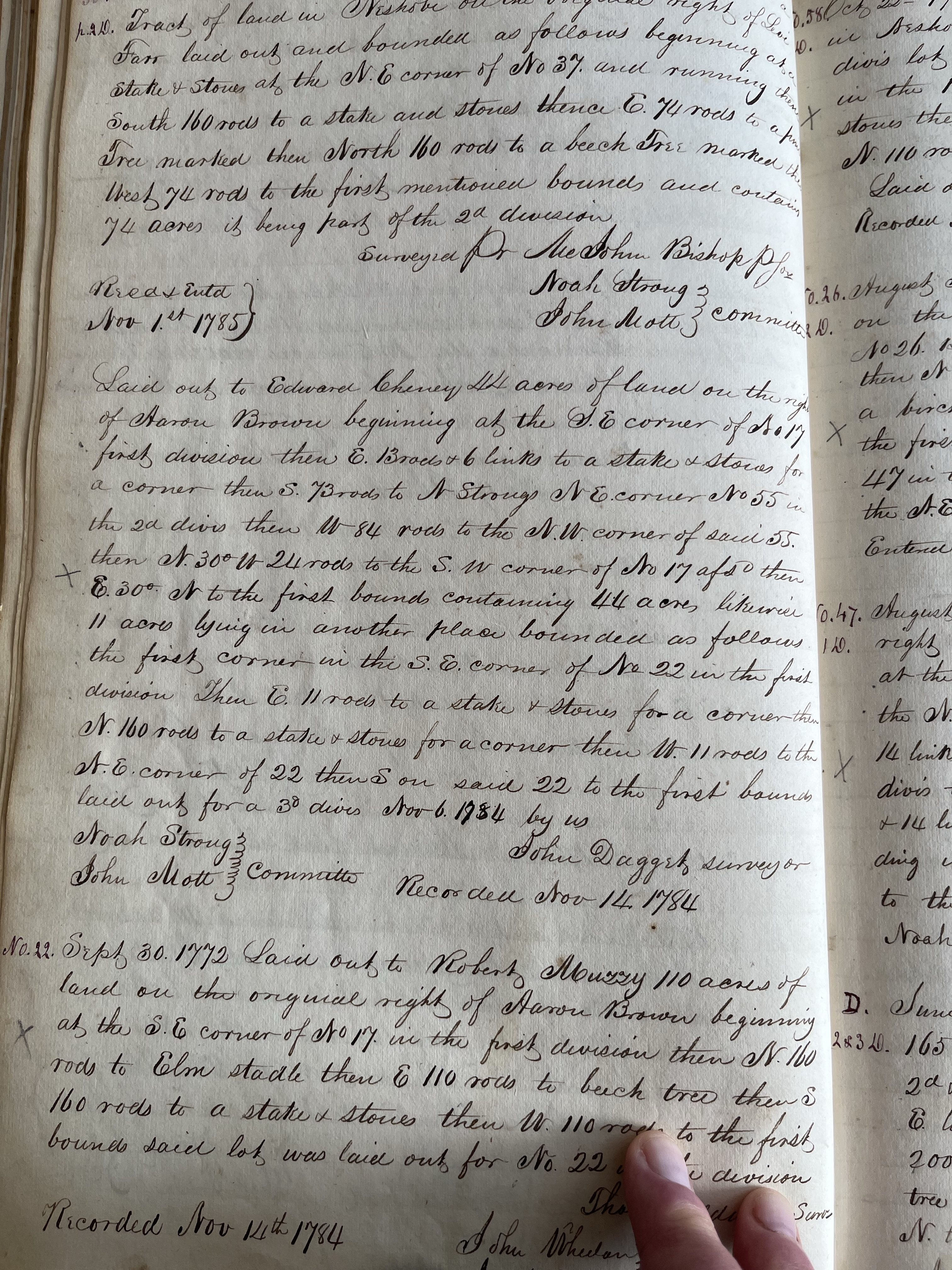
Laid out to Edward Cheney 44 acres of land on the right of Aaron Brown beginning at the SE corner of No 17 first division then E 13 rods and 6 links to a stake & stones for a corner then S 73 rods to N Strongs NE corner No55 in the 2nd Divis then W 84 rods to the NW corner of said 55. then N 30 degrees W 24 rods to the SW corner of No 17 aforesaid then E 30 degrees N to the first bounds containing 44 acres likewise 11 acres lying in another place bounded as follows the first corner in the SE corner of No 22 in the first division Then E 11 rods to a stake & stones for a corner then N 160 rods to a stake & stones for a corner then W 11 rods to the NE corner of 22 then South on said 22nd to the first bounds laid out for a 3d divis November 6 1784 by us

Noah Strong }

John Mott} Committee

John Daggert, Surveyor

Recorded November 14th 1784

1784 Survey of Edward Cheney’s land in Brandon VT
Posted in 1790s, Cheney, Land, Vermont | Tagged , , , | Leave a comment

1800 Survey of Edward Cheney’s land in Brandon VT

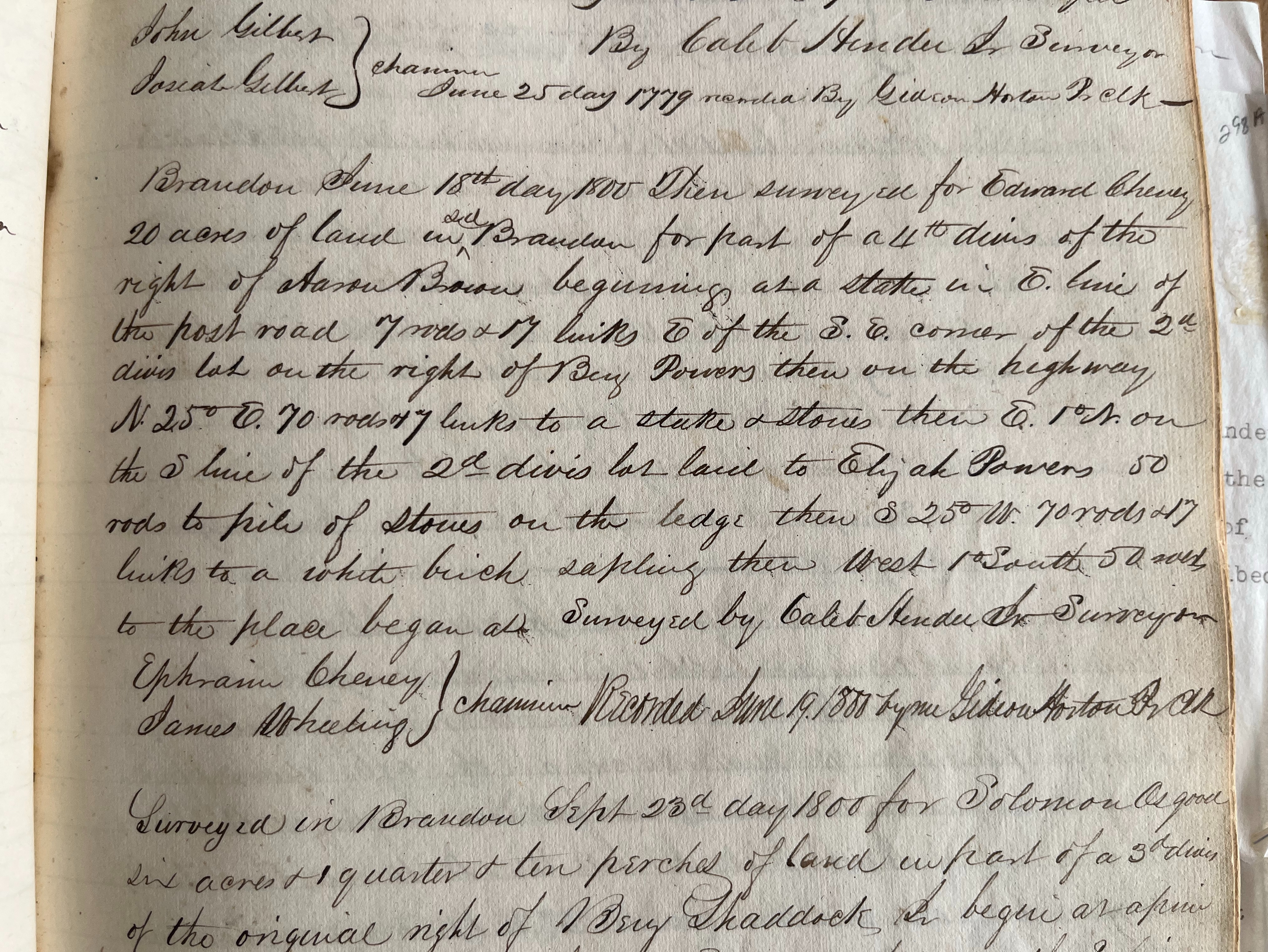
Brandon. June 18th day 1800. Then surveyed for Edward Cheney 20 acres of land in said Brandon for part of a 4th division of the right of Aaron Brown beginning as a stake in east line of the post road 7 rods and 17 links E of the S.E. corner of the 2nd divis lot on the right of Benjamin Powers then on the highway N 20 degrees E 70 rods & 7 links to a stake & stones then east 1 degree N on the South line of the 2d divis lot laid to Elijah Powers 50 rods to a pile of stones on the ledge then S 25 degrees W 70 rods & 17 links to a white birch sapling then W 1 degree S 50 rods to the place began at. Surveyed by Caleb Henderson senior surveyor

Ephraim Cheney}

 James Wheeling} Chairmen

recorded June 19th 1800 by me Gideon Horton [Illeg] Clk.

1800 survey of Edward Cheney’s land
Posted in 1800s, Cheney, Land, Vermont | Tagged , , , , , , , | Leave a comment

Chapel Cheney Quit Claim to Albin Lull, 1830

p. 420

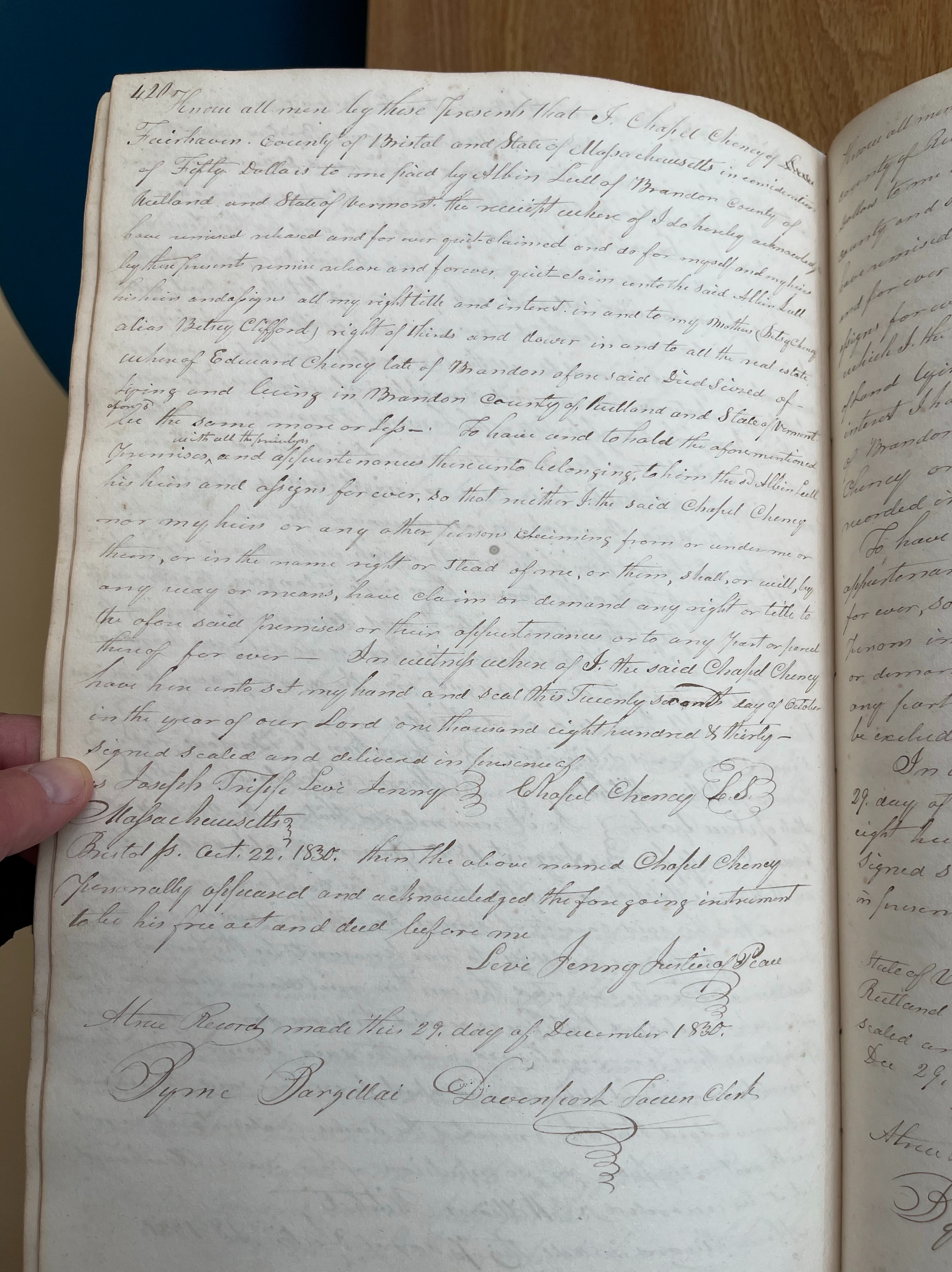
Know all men by these presents that I, Chapel Cheney of Fairhaven, county of Bristol and State of Massachusetts in consideration of Fifty Dollars to me paid by Albin Lull of Brandon County of Rutland and State of Vermont, the receipt whereof I do hereby acknowledge have remised [?] released and for ever quit claimed and do for myself and my heirs by these presents remise release and for ever quit claim unto the said Albin Lull his heirs and assigns all my right title and interest in and to my mother’s (Betsey Cheney alias Betsy Clifford) right of thirds and dower in and to all the real estate whereof Edward Cheney late of Brandon aforesaid died seized of lying and living in Brandon County of Rutland and State of Vermont aforesaid the same more or less. To have and to hold the aforementioned premises with all the privileges and appurtenances thereunto belonging, to him the said Albin Lull his heirs and assigns forever, so that neither I, the said Chapel Cheney nor my heirs or any other person claiming from or under me or them, or in the name right or stead of me, or them, shall, or will, by any way or means, have claim or demand any right or title to the aforesaid premises or their appurtenances or to any part or parcel thereof forever – In witness whereof I, the said Chapel Cheney, have hereto set my hand and seal this twenty second day of October in the year of our Lord one thousand eight hundred & thirty.

Signed sealed and delivered in presence of Joseph Tripple Levi Jenney  } Chapel Cheney

Massachusetts

Bristol October 22nd 1830 the above named Chapel Cheney personally appeared and acknowledged the aforesaid instrument to be to be his free act and deed before me Levi Jenney Justice of Peace

A true record made this 29 day of December 1830 by me Barzillai Davenport Town Clerk

Chapel Cheney Quit Claim 1830

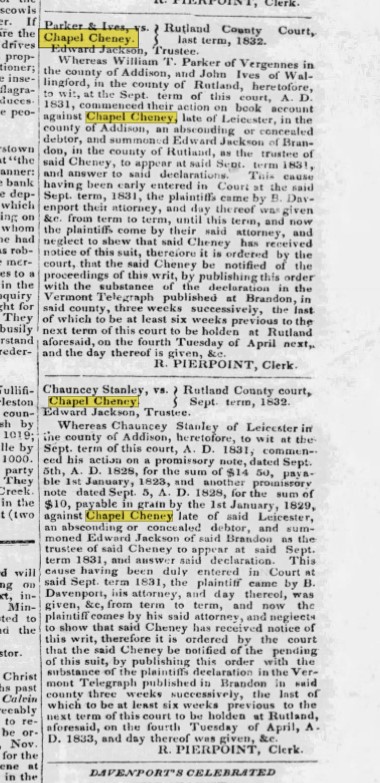
N.B. Chapel Cheney (b 1809) was a son of Deacon Edward and Elizabeth Gilbert. He did not live up to his name. In 1832, two years after selling his interest in his mother’s estate for $50, he was sued by two separate parties in Brandon for unpaid debts. Elizabeth (Betsey) ended up living until 1860. I can just see a 21 year old kid needing quick cash and selling the future interest in his parents’ estate.

Posted in 1830s, Black sheep, Cheney, Vermont | Tagged , | Leave a comment